
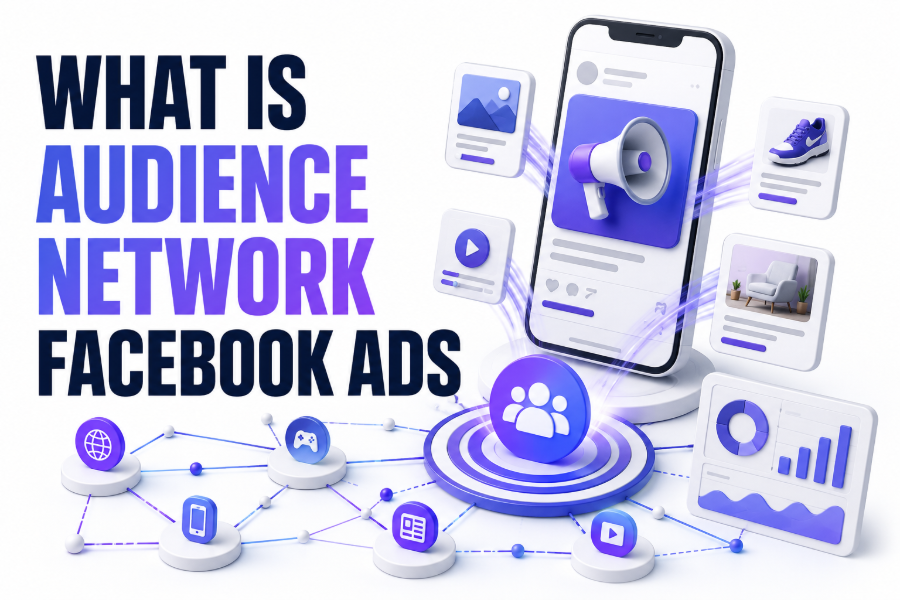
Facebook advertising is no longer limited to content shown inside Facebook or Instagram. Meta allows advertisers to extend selected campaigns across external mobile apps, websites, and video environments through a placement known as Audience Network.
What is Audience Network Facebook ads helps marketers decide whether this placement supports their campaign goals. It can provide additional reach, lower-cost impressions, and access to people while they use digital platforms outside Meta’s main applications.
However, broader reach does not automatically produce better business results. Advertisers need to understand where these ads appear, how Meta selects users, which formats are supported, and how Audience Network performance should be measured separately from other placements.
Audience Network Facebook Ads
Audience Network is an advertising placement that extends Meta campaigns beyond Facebook and into participating third-party digital environments. Depending on campaign eligibility and available inventory, advertisements may appear in mobile apps, websites, and video players used by Meta’s publishing partners.
Advertisers do not normally create a completely separate campaign for Audience Network. Instead, they build campaigns through Meta Ads Manager and include Audience Network as an available placement when the selected objective, format, device, and campaign settings support it.
Meta uses the targeting and delivery system connected with its advertising platform to determine who may see each ad. This means businesses can extend an existing campaign while maintaining its audience settings, creative assets, budget strategy, and optimization event.
The Purpose of Meta Audience Network
The main purpose of Audience Network is to give advertisers additional opportunities to reach relevant users beyond Meta-owned platforms. A person may leave Facebook but still encounter an eligible Meta advertisement while using another mobile application or watching supported video content.
This extended inventory may help Meta find more delivery opportunities when Facebook and Instagram placements become competitive. It can also help campaigns generate additional impressions, video views, clicks, app activity, or conversions without requiring advertisers to negotiate directly with individual publishers.
For participating publishers, the network creates a way to monetize eligible apps or digital content by displaying advertisements. Meta manages important parts of the ad-delivery process, while publishers provide the spaces in which approved advertisements may be displayed.
Core Characteristics of Audience Network
- Ads appear beyond Facebook and Instagram.
- Delivery uses Meta’s advertising technology.
- Campaigns are managed through Meta Ads Manager.
- Availability depends on the selected campaign settings.
- Ads can appear within participating third-party environments.
- Performance can be reviewed by placement.
- Advertisers may use automatic or manual placements.
The Difference Between Audience Network and Facebook Ads
Facebook ads describe paid advertisements that are created and managed through Meta’s advertising system. These campaigns may appear across several platforms and placements, including Facebook Feed, Instagram Stories, Messenger, Reels, and eligible Audience Network inventory.
Audience Network is therefore not a separate advertising manager. It is one possible delivery environment inside the wider Meta advertising ecosystem. The distinction relates mainly to location: Facebook placements appear on Facebook, while Audience Network placements extend into participating external properties.
This difference is important because user behavior can vary across platforms. Someone scrolling through Facebook may have a different level of attention or purchase intent than someone viewing an advertisement during a game, article, utility application, or video experience.
The Audience Network Advertising Process
The process begins when an advertiser creates a campaign in Meta Ads Manager. The advertiser selects an objective, defines an audience, sets a budget, chooses an optimization event, and uploads creative materials such as images, videos, headlines, descriptions, and destination links.
When Audience Network is included, Meta evaluates available advertising opportunities across eligible publishers. Its delivery system considers factors such as audience relevance, campaign objectives, estimated action rates, bid strategy, budget, creative compatibility, and available inventory before serving an advertisement.
Users may then interact with the ad by watching a video, clicking a link, installing an application, visiting a landing page, or completing another measurable action. The campaign data is recorded in Ads Manager and attributed according to the advertiser’s reporting settings.
Typical Audience Network Delivery Flow
- The advertiser creates a campaign in Meta Ads Manager.
- Audience targeting and campaign goals are selected.
- Eligible placements are enabled.
- Meta identifies available publisher inventory.
- The advertisement is delivered to relevant users.
- User activity is measured and reported.
- Delivery is adjusted according to performance signals.
Available Audience Network Ad Formats
Meta Audience Network supports formats designed to fit different app, website, and video experiences. Available options may depend on the campaign objective, publisher inventory, placement eligibility, device, and current Meta advertising specifications.
Native advertisements are designed to match the surrounding layout of an application or content environment. Instead of appearing as an unrelated promotional box, the advertisement can follow the publisher’s visual structure while remaining identifiable as sponsored content.
Banner, interstitial, rewarded video, and other video-based experiences may also be available. Meta’s documentation describes native and banner advertising among its Audience Network formats, while video campaigns may appear in supported apps, websites, and video players.
Native Ads Within Audience Network
Native ads are integrated into the visual experience of a participating app or publishing environment. Their fonts, spacing, layout, and positioning may resemble surrounding content, although proper disclosures should make it clear that the material is an advertisement.
This format may feel less disruptive than a large pop-up or full-screen promotion. When the creative and offer match the user’s interests, native placements can attract attention without completely interrupting the activity being performed inside the app.
Advertisers should still use clear branding and understandable messages. A native layout can make an advertisement feel natural, but weak headlines, confusing visuals, or misleading calls to action can reduce trust and generate clicks that do not become valuable results.
Common Audience Network Format Uses
| Ad format | Common purpose | User experience |
|---|---|---|
| Native ads | Traffic and conversions | Blends with surrounding content |
| Banner ads | Reach and awareness | Appears in a smaller fixed area |
| Interstitial ads | Engagement and app promotion | Uses a larger screen area |
| Rewarded video | App and game engagement | Offers an in-app benefit |
| Video placements | Awareness and video viewing | Appears within video environments |
Banner and Interstitial Advertising
Banner advertisements generally appear in smaller areas near the top or bottom of a mobile screen. They can deliver frequent visibility without occupying the entire interface, although limited space requires short copy, recognizable branding, and simple visual communication.
Interstitial advertisements use a larger portion of the screen and often appear during a natural transition. For example, an ad might be displayed between levels, content screens, or stages of an application experience rather than appearing during a sensitive user action.
These formats can produce broad exposure, but advertisers should review engagement quality carefully. Accidental clicks may occur when an ad appears near navigation controls or during rapid app interactions, so click volume alone should not determine whether the placement is valuable.
Rewarded Video and Video Placements
Rewarded video advertisements are commonly associated with mobile apps and games. Users may choose to watch an advertisement in exchange for an in-app benefit, such as additional content, virtual currency, another attempt, or temporary access to a feature.
Because the user voluntarily starts the experience, rewarded video can generate completed views. However, the viewer’s primary motivation may be receiving the reward rather than learning about the advertiser, which can affect click quality and post-view conversion behavior.
Other eligible video placements may appear across supported video players and digital environments. Advertisers should communicate their main message early, include visible branding, use captions when appropriate, and ensure the creative remains understandable without relying completely on sound.
Effective Video Creative Elements
- Visible branding within the opening seconds
- A clear product or service demonstration
- Mobile-friendly framing and readable text
- One focused message for each advertisement
- Captions for sound-off viewing
- A relevant and direct call to action
- A landing page matching the advertisement
Automatic and Manual Placement Options
Meta Ads Manager generally allows advertisers to use automatic placement recommendations or select placements manually. Meta’s current placement guidance explains that placement availability depends on factors such as campaign objective, advertisement type, settings, and supported destinations.
Automatic placements allow Meta’s delivery system to distribute the budget across eligible locations. The system can explore Facebook, Instagram, Messenger, and Audience Network inventory, then adjust delivery toward available opportunities associated with the campaign’s optimization goal.
Manual placements provide greater control over where advertisements may appear. An advertiser can include or remove Audience Network when supported, although reducing placement options may restrict delivery, increase costs, or limit Meta’s ability to identify efficient opportunities.
Benefits of Audience Network Facebook Ads
Audience Network can expand campaign reach beyond users who are actively browsing Meta-owned applications. This additional scale may be valuable for awareness, video, mobile-app, traffic, retargeting, or conversion campaigns with enough data and suitable creative assets.
The placement may provide lower-cost impressions or clicks in some accounts because publisher inventory can have different levels of competition. Lower costs can increase campaign volume, but marketers should compare business outcomes rather than treating inexpensive traffic as automatic evidence of success.
Advertisers can also manage Audience Network through the same reporting and campaign system used for other Meta placements. This simplifies budgeting, creative management, audience selection, conversion tracking, and cross-placement analysis for businesses already familiar with Ads Manager.
Potential Audience Network Advantages
- Additional reach beyond Meta applications
- More opportunities for campaign delivery
- Access to mobile-first audiences
- Multiple creative formats
- Centralized management through Ads Manager
- Potentially efficient impressions or video views
- Placement-level reporting
- Support for broader campaign scaling
Limitations and Performance Concerns
Audience Network traffic may not always carry the same level of intent as Facebook Feed, Instagram Feed, Search, or retargeting placements. Users may be focused on another activity and interact with an advertisement without being prepared to purchase immediately.
Click quality can also vary across apps, publishers, formats, countries, and devices. A campaign may report a strong click-through rate while producing weak time on page, low lead quality, limited checkout activity, or few completed purchases.
Brand context is another consideration. Advertisers may not always evaluate every environment before delivery begins, so suitability controls and placement reporting deserve attention. Campaign managers should monitor where possible and ensure their creative remains appropriate for varied mobile experiences.
Audience Network Cost Structure
Audience Network does not have one fixed advertising price. Campaign costs are influenced by audience competition, objective, geography, season, industry, bid strategy, optimization event, creative quality, expected response, available inventory, and overall advertiser demand.
Common performance metrics include cost per thousand impressions, cost per click, cost per landing-page view, cost per lead, cost per install, and cost per purchase. The most useful metric depends on the campaign’s actual objective and business model.
A low cost per click may appear attractive, but it becomes less useful when visitors leave immediately or fail to complete meaningful actions. Advertisers should evaluate total acquisition cost, conversion rate, revenue, lead quality, and return on advertising spend.
Metrics Worth Monitoring
| Metric | What it indicates |
|---|---|
| CPM | Cost for one thousand impressions |
| CTR | Percentage of impressions producing clicks |
| CPC | Average cost for each click |
| Landing-page views | Visitors who loaded the destination page |
| Conversion rate | Percentage completing the desired action |
| Cost per result | Average cost of the selected outcome |
| ROAS | Revenue compared with advertising spending |
| Frequency | Average number of exposures per person |
Suitable Campaigns for Audience Network
Audience Network may suit campaigns that need additional scale and have mobile-friendly destinations. App-install campaigns, video campaigns, broad awareness efforts, and established conversion campaigns may gain useful delivery opportunities from supported external placements.
It may also help advertisers who already have strong creative assets, clear conversion tracking, and enough budget for testing. Businesses can compare placement-level performance and determine whether Audience Network contributes incremental conversions or mainly produces low-value activity.
Campaigns with complex forms, desktop-focused pages, luxury offers, or highly specific professional audiences may require closer monitoring. Suitability depends on evidence from the account rather than a universal rule applying to every industry, audience, product, or funnel.
Campaigns Requiring Additional Caution
Lead-generation campaigns should be assessed using lead quality rather than submission volume alone. A placement that produces many inexpensive forms can still be inefficient when contacts contain inaccurate details, show little interest, or rarely respond to sales follow-up.
E-commerce advertisers should examine add-to-cart activity, checkout progression, purchase value, refund behavior, and new-customer profitability. Placement decisions based only on link clicks can hide major differences between casual visitors and users with genuine buying intent.
Advertisers operating in regulated, sensitive, or reputation-focused industries should review Meta’s current advertising rules and suitability controls. They should also ensure that landing pages, claims, disclosures, targeting choices, and creative materials follow relevant platform requirements and applicable regulations.
Signs That Closer Review Is Needed
- Clicks increase without additional conversions.
- Landing-page views remain far below link clicks.
- Bounce or engagement quality becomes weaker.
- Leads provide incomplete or inaccurate information.
- Purchases have unusually low average values.
- The placement spends heavily without assisted results.
- Mobile pages load slowly.
- Creative receives attention but not business actions.
Audience Network Setup in Meta Ads Manager
Begin by opening Meta Ads Manager and creating a campaign with an objective that supports the desired placement. Define the conversion location, performance goal, audience, budget, schedule, attribution settings, and other campaign details relevant to the selected objective.
At the ad-set level, locate the placement settings. Automatic placements may include Audience Network when the campaign is eligible. With manual placements, advertisers can review available platforms and choose supported Audience Network options based on their strategy.
Complete the advertisement with compatible creative, copy, destination information, and tracking. Before publishing, review the preview options, conversion event, mobile experience, URL parameters, and campaign settings to reduce reporting problems after spending begins.
Audience Network Performance Analysis
Placement-level reporting is necessary because blended campaign totals can hide major performance differences. In Ads Manager, advertisers can use reporting breakdowns to compare Audience Network results with Facebook, Instagram, Messenger, and individual placement categories.
Start with the metric that matches the campaign objective. Awareness campaigns may emphasize reach and completed views, while conversion campaigns should prioritize purchases, qualified leads, acquisition cost, customer value, and revenue rather than surface-level engagement.
Avoid making major decisions from a very small sample. A few clicks or one conversion may create misleading averages. Allow enough delivery for patterns to emerge, while maintaining sensible limits when spending produces clear evidence of poor-quality results.
A Practical Placement Review Method
- Select the relevant campaign period.
- Break results down by platform and placement.
- Compare spending and primary results.
- Review landing-page and conversion behavior.
- Examine lead or customer quality.
- Check whether results are direct or assisted.
- Adjust placements, creative, or budget carefully.
- Measure performance again after the change.
Optimization Practices for Better Results
Use creative designed for small mobile screens. The advertisement should communicate its subject quickly, display the brand clearly, and make the desired next step understandable without requiring users to read long blocks of text.
The landing page should load quickly and maintain message consistency. When the advertisement promises a guide, discount, demonstration, or product benefit, the destination should immediately support that promise rather than forcing visitors to search for relevant information.
Advertisers should test Audience Network against other placements instead of assuming it will succeed or fail. Controlled comparisons involving creative, audience, optimization events, and conversion quality provide more reliable guidance than general opinions about the placement.
Common Audience Network Mistakes
One common mistake is judging success through cheap clicks. Clicks are intermediate actions, not final business outcomes. An advertiser may receive large traffic volume while generating very few sales, qualified leads, bookings, subscriptions, or retained app users.
Another mistake is using the same creative without checking how it appears across different formats. Text-heavy images, small product details, unclear cropping, or slow introductions may perform poorly in compact banners, native layouts, or short video experiences.
Advertisers also make weak decisions when they disable placements after limited spending or leave unproductive delivery unchanged for too long. Optimization requires enough data for comparison, clear success criteria, and regular review based on meaningful campaign outcomes.
Internal Learning Resources
Advertisers who are new to campaign creation can review a detailed guide on how to run a successful Facebook ad campaign before testing external placements.
For broader platform management, a guide covering how to use Facebook Ads Manager can help with campaign creation, reporting, budget control, placement selection, and performance analysis.
Audience Network Brand Safety Considerations
Brand safety refers to reducing the likelihood that advertisements appear near unsuitable content or within environments that conflict with a company’s values. The concern becomes relevant whenever campaigns extend across a large collection of third-party properties.
Meta states that it works directly with publishers for Audience Network inventory rather than purchasing supply through open ad exchanges. Advertisers should still review the latest placement information, controls, policies, and reporting options available inside their accounts.
Companies with strict requirements may prefer more controlled placement strategies. Others may accept broader delivery when conversion performance remains strong. The appropriate decision depends on brand standards, risk tolerance, campaign purpose, available controls, and the quality of measured outcomes.
Audience Network Versus Other Meta Placements
Facebook and Instagram placements often benefit from familiar social interfaces where users expect to discover posts, creators, brands, products, and recommendations. These environments may support stronger engagement when the creative resembles useful or entertaining platform content.
Audience Network reaches users in external digital contexts. It can add scale, but the surrounding activity may influence attention and intent. A person using a game or utility application may respond differently from someone browsing a Feed or watching Reels.
Neither placement category is automatically superior. The strongest combination depends on the campaign objective, audience behavior, creative format, conversion path, and measured profitability. Placement-level analysis should guide allocation instead of assumptions based on platform names.
Simplified Placement Comparison
| Placement category | Main environment | Typical strength |
|---|---|---|
| Facebook Feed | Social content browsing | Engagement and conversion intent |
| Instagram Feed | Visual content discovery | Product and brand presentation |
| Stories and Reels | Full-screen vertical content | Video reach and engagement |
| Messenger | Messaging environment | Conversation-related actions |
| Audience Network | External apps and digital content | Extended reach and additional inventory |
Final Thoughts
Audience Network is an extension of Meta’s advertising system that helps eligible campaigns appear beyond Facebook and Instagram. It gives advertisers access to participating mobile apps, websites, and video environments while retaining Meta’s campaign management and targeting structure.
Its main advantages include broader reach, additional inventory, mobile-focused formats, and centralized reporting. Its limitations may include inconsistent traffic quality, accidental interactions, varied user intent, and performance differences between publishers, devices, and creative formats.
What is Audience Network Facebook ads allows advertisers to use the placement with realistic expectations. The most suitable approach is to test it with accurate tracking, compare placement-level outcomes, review customer quality, and base future decisions on meaningful business results.
FAQ’S
Is Audience Network part of Facebook advertising?
Yes. Audience Network is a placement available within Meta’s advertising ecosystem. It lets eligible advertisements extend beyond Facebook and Instagram into participating third-party apps, websites, and video environments while campaigns remain managed through Meta Ads Manager.
Can Audience Network produce sales and leads?
Audience Network can generate sales, installations, traffic, video views, and leads when the audience, offer, creative, landing page, and optimization settings are suitable. Results vary, so advertisers should evaluate conversion quality and profitability rather than relying only on clicks.
Should Audience Network be turned off?
It should not be disabled automatically. Advertisers should first review placement-level spending, conversions, lead quality, landing-page activity, and return on advertising spend. Removing the placement may be reasonable when reliable data shows consistently weak business results.
Where do Audience Network advertisements appear?
Eligible advertisements can appear across participating third-party apps, websites, and video environments. Exact availability depends on the campaign objective, format, device, publisher inventory, account settings, and current placement options supported by Meta.
Is Audience Network suitable for every campaign?
No placement is suitable for every campaign. Audience Network may support scale, awareness, video viewing, app promotion, traffic, or conversions, but businesses with complex offers or strict quality requirements may need more detailed testing and monitoring.
0 Comments